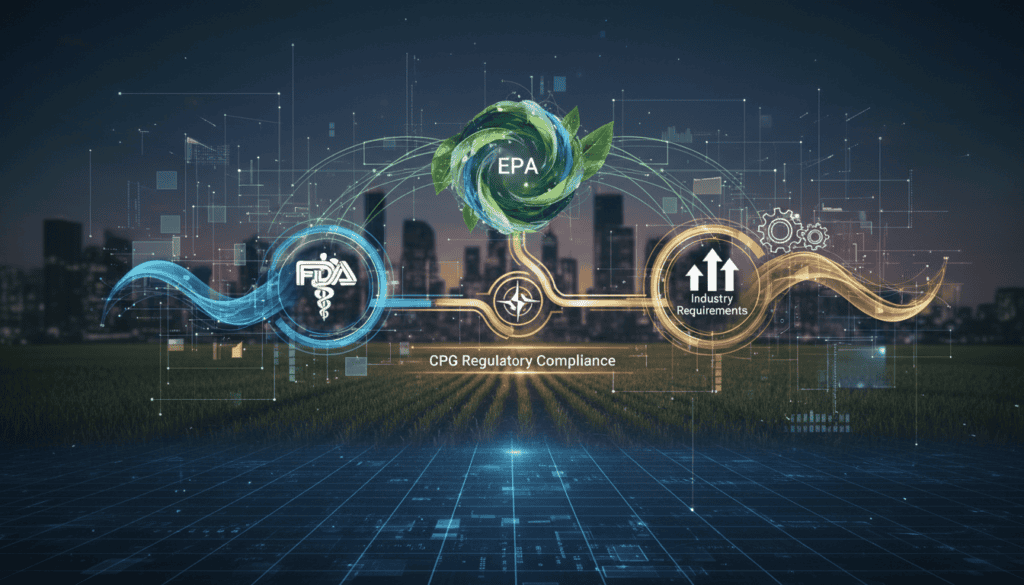
A single mislabeled ingredient can trigger million-dollar recalls, class-action lawsuits, and permanent brand damage in the consumer packaged goods industry. Yet many CPG companies still treat regulatory compliance as an afterthought rather than the business-critical foundation it truly is. The maze of FDA, EPA, and industry-specific requirements isn’t just bureaucratic red tape—it’s your brand’s first line of defense.

Understanding the CPG Regulatory Landscape
The consumer packaged goods industry operates under some of the most stringent regulatory oversight in the business world. You’re not just dealing with one agency—you’re navigating a complex web of federal, state, and industry requirements that can vary dramatically based on your product category.
Here’s what makes CPG compliance particularly challenging: regulations change frequently, enforcement varies by region, and the stakes couldn’t be higher. A compliance misstep doesn’t just mean a warning letter—it can mean product seizures, facility shutdowns, and criminal charges for executives.
The Multi-Agency Challenge
Most CPG companies must answer to multiple regulatory bodies simultaneously. The FDA oversees food, drugs, cosmetics, and medical devices. The EPA handles pesticides, cleaning products, and environmental claims. The FTC monitors advertising and marketing claims. State agencies add another layer of complexity with their own requirements.
This overlap creates gaps where products can fall through regulatory cracks—and companies get blindsided by enforcement actions they never saw coming.
FDA Requirements for CPG Companies
The Food and Drug Administration’s reach extends far beyond what most business owners realize. If you’re manufacturing or marketing food, beverages, dietary supplements, cosmetics, over-the-counter drugs, or medical devices, you’re operating in FDA territory.
Food Safety Modernization Act (FSMA) Compliance
FSMA fundamentally changed how food companies operate. You’re no longer just responsible for responding to contamination—you must prevent it. This means:
- Developing and maintaining written food safety plans
- Conducting hazard analyses for every product and process
- Setting up preventive controls with monitoring procedures
- Maintaining detailed records of all safety activities
- Undergoing regular third-party audits
The reality is that FSMA compliance isn’t a one-time project. It’s an ongoing operational requirement that touches every aspect of your business, from supplier relationships to facility design.
Labeling and Claims Substantiation
FDA labeling requirements go deep into the details. Every nutrient claim, health benefit, and marketing statement must be backed by scientific evidence. You can’t just say your product is “natural” or “supports immune health” without proper substantiation.
Here’s what trips up most companies: the FDA doesn’t pre-approve labels. You’re responsible for ensuring compliance before your product hits the market. Get it wrong, and you’ll face warning letters, product recalls, and potential lawsers from competitors and consumers.
Facility Registration and Inspection Readiness
Every facility that manufactures, processes, packs, or holds food for human consumption must register with the FDA. But registration is just the beginning. You need to be inspection-ready at all times.
FDA inspectors can show up unannounced, and they’re looking for more than just clean facilities. They want to see your documentation, review your procedures, and verify that you’re actually following the plans you’ve put in place.
EPA Regulations and Environmental Compliance
Environmental Protection Agency oversight hits CPG companies from multiple angles. If your products contain pesticides, make antimicrobial claims, or could impact environmental safety, EPA regulations apply to you.
Pesticide Registration and FIFRA Compliance
The Federal Insecticide, Fungicide, and Rodenticide Act (FIFRA) requires registration for any product that claims to kill, repel, or mitigate pests. This includes obvious products like bug sprays and weed killers, but also less obvious items like antimicrobial soaps, mold-resistant paints, and treated fabrics.
FIFRA compliance involves:
- Extensive toxicity testing and environmental impact studies
- Detailed product chemistry data and manufacturing information
- Proof that your product performs as claimed
- Ongoing reporting and fee payments
- State-by-state registration in many cases
Most businesses underestimate the time and cost involved in pesticide registration. You’re looking at months or years for approval, and hundreds of thousands of dollars in testing and registration fees.
Toxic Substances Control Act (TSCA) Requirements
TSCA governs chemical substances used in commerce. If you’re manufacturing products with chemical ingredients, you need to ensure those substances are properly registered and comply with safety requirements.
The 2016 TSCA amendments gave EPA more authority to require safety testing and restrict dangerous chemicals. This means ongoing monitoring of your ingredient lists and staying current with changing safety assessments.
Environmental Marketing Guidelines
The EPA’s environmental marketing guidelines affect how you can promote your products’ environmental benefits. Terms like “eco-friendly,” “biodegradable,” and “recyclable” have specific requirements for substantiation.
Here’s the challenge: consumers want environmentally responsible products, but overstating environmental benefits can trigger enforcement actions and consumer lawsuits. You need solid scientific backing for any environmental claims.

Industry-Specific Requirements and Standards
Beyond federal agencies, CPG companies must navigate industry-specific requirements that vary by product category, distribution channels, and target markets.
Retailer Requirements and Audits
Major retailers often impose their own compliance requirements that go beyond regulatory minimums. Walmart, Target, Amazon, and other retail giants have specific standards for:
- Product testing and certification
- Supply chain transparency and documentation
- Packaging and labeling specifications
- Quality assurance and recall procedures
- Sustainability and social responsibility metrics
Failing retailer audits can mean losing major distribution channels. Some companies find retailer requirements more challenging than regulatory compliance because they’re often more stringent and change more frequently.
Third-Party Certifications
Consumer demand drives many CPG companies toward third-party certifications like organic, non-GMO, fair trade, and various safety standards. These certifications involve their own compliance requirements, audit processes, and ongoing monitoring.
The key insight here: certifications can be powerful marketing tools, but they also create additional compliance obligations. You’re not just meeting regulatory requirements—you’re meeting the standards of certification bodies that may be even more strict.
International Compliance Considerations
If you’re selling internationally or sourcing ingredients globally, you’re dealing with multiple regulatory systems simultaneously. European Union regulations, Health Canada requirements, and other international standards often differ significantly from US requirements.
This creates complex decisions about product formulations, labeling, and documentation. Many companies find they need different versions of products for different markets, which multiplies compliance complexity.
Building an Effective Compliance Management System
Successful CPG compliance isn’t about perfect adherence to every rule—it’s about building systems that identify, assess, and manage regulatory risks before they become business problems.
Risk Assessment and Prioritization
Start with a complete assessment of your regulatory exposure. Map every product, ingredient, claim, and process against applicable regulations. This isn’t a one-person job—you need input from R&D, marketing, operations, and legal teams.
Once you understand your exposure, prioritize risks based on probability and impact. A mislabeled allergen carries higher risk than a minor formatting error. Focus your resources on the highest-risk areas first.
Documentation and Record-Keeping Systems
Compliance documentation needs to be more than filing cabinets full of certificates. You need systems that track:
- Ingredient specifications and supplier certifications
- Testing results and certificate of analysis for every batch
- Label approvals and substantiation for all claims
- Training records and competency assessments
- Audit findings and corrective action plans
Digital document management systems aren’t just convenient—they’re essential for demonstrating compliance during inspections and audits.
Supplier Management and Supply Chain Oversight
Your compliance is only as strong as your weakest supplier. You’re responsible for ensuring that ingredients, packaging materials, and co-manufactured products meet all applicable requirements.
This means qualification processes for new suppliers, ongoing monitoring of existing suppliers, and clear contractual requirements for compliance documentation. You can’t just trust that suppliers are handling compliance—you need verification systems.
Staying Current with Regulatory Changes
Regulatory requirements don’t stand still. New regulations emerge, existing rules get updated, and enforcement priorities shift. Your compliance program needs mechanisms for staying current.
Monitoring and Alert Systems
Set up systematic monitoring of regulatory developments that affect your business. This might include:
- Subscriptions to agency newsletters and updates
- Trade association monitoring services
- Legal counsel updates on regulatory changes
- Industry conference attendance and networking
The goal isn’t to track every regulatory development—it’s to identify changes that materially affect your products and operations before they take effect.
Training and Communication Programs
Regulatory knowledge needs to reach everyone who makes decisions affecting compliance. This includes obvious roles like quality assurance and regulatory affairs, but also marketing, product development, and operations teams.
Regular training programs should cover both general compliance principles and specific requirements for your products and markets. Make sure people understand not just what the rules are, but why they exist and how violations can impact the business.

Managing Compliance Costs and Resources
Compliance isn’t free, but non-compliance costs much more. Smart companies find ways to manage compliance costs while maintaining effectiveness.
Internal vs. External Resources
Decide what compliance activities to handle internally versus outsourcing to specialists. Core activities like daily operations monitoring and documentation should typically stay internal. Specialized activities like toxicology studies and regulatory submissions often make sense to outsource.
The decision isn’t just about cost—it’s about expertise and capacity. Regulatory requirements are complex and changing. Sometimes external specialists deliver better results at lower total cost.
Technology and Automation Solutions
Compliance technology can reduce both costs and risks. Software solutions can automate documentation, track regulatory changes, manage supplier information, and streamline audit processes.
But technology isn’t a magic bullet. You still need human expertise to interpret requirements, assess risks, and make judgment calls. Technology should support your compliance program, not replace it.
Crisis Management and Enforcement Response
Even the best compliance programs face challenges. Having plans for managing regulatory crises can mean the difference between minor disruptions and major business damage.
Recall Planning and Execution
Product recalls are one of the most serious compliance challenges. You need detailed plans that cover:
- Decision-making processes for voluntary recalls
- Communication protocols for customers, regulators, and media
- Logistics for retrieving and disposing of recalled products
- Documentation and reporting requirements
- Investigation procedures to prevent recurrence
Practice your recall procedures regularly. When a real crisis hits, you won’t have time to figure out processes on the fly.
Inspection and Audit Response
Regulatory inspections are stressful, but they’re also opportunities to demonstrate your commitment to compliance. Train your team on inspection protocols, document review procedures, and communication guidelines.
The key principle: be cooperative and transparent without volunteering unnecessary information. Answer questions directly and provide requested documentation promptly, but don’t speculate or make commitments you can’t keep.
Future-Proofing Your Compliance Strategy
Regulatory trends point toward increased oversight, higher penalties, and greater emphasis on prevention rather than reaction. Companies that get ahead of these trends will have competitive advantages.
Emerging Regulatory Trends
Several trends are shaping the future of CPG regulation:
- Increased focus on supply chain transparency and traceability
- Greater scrutiny of environmental and sustainability claims
- Enhanced requirements for product safety testing and documentation
- Stricter enforcement with higher penalties for violations
- More coordination between federal, state, and international regulators
Companies that prepare for these trends now will adapt more easily as requirements evolve.
Building Compliance into Business Strategy
The most successful CPG companies treat compliance as a competitive advantage rather than a necessary cost. They build compliance considerations into product development, marketing strategies, and market expansion plans from the beginning.
This approach prevents costly redesigns and regulatory delays later. It also creates opportunities to differentiate products based on safety, quality, and transparency—attributes that increasingly matter to consumers.
Conclusion: Turning Compliance into Competitive Advantage
CPG regulatory compliance isn’t just about avoiding problems—it’s about building trust with customers, retailers, and regulators that translates into business success. Companies that view compliance strategically rather than reactively create sustainable competitive advantages in increasingly crowded markets.
The investment in robust compliance systems pays dividends beyond risk mitigation. It enables faster product launches, smoother retailer relationships, and stronger consumer confidence. Most importantly, it provides the foundation for sustainable growth in regulated industries.
At Beast Creative Agency, we understand that compliance excellence requires more than just following rules—it requires strategic communication that builds trust and demonstrates value. Our experienced team helps CPG companies translate their compliance investments into compelling brand stories that resonate with customers and drive business results. Ready to turn your regulatory expertise into a marketing advantage? Let’s discuss how our AI-enhanced campaigns and radical transparency approach can help your compliant brand stand out in the marketplace.