Nearly 70% of CPG brands face a pivotal production decision within their first three years: stick with co-packing partners or bring manufacturing in-house. This choice doesn’t just affect your bottom line—it shapes your brand’s entire operational DNA. The decision you make today will ripple through every aspect of your business for years to come.

Understanding the CPG Production Landscape
The consumer packaged goods industry has evolved dramatically over the past decade. Gone are the days when brands had limited options for bringing products to market. Today’s CPG companies operate in a dynamic environment where production flexibility can make or break market entry strategies.
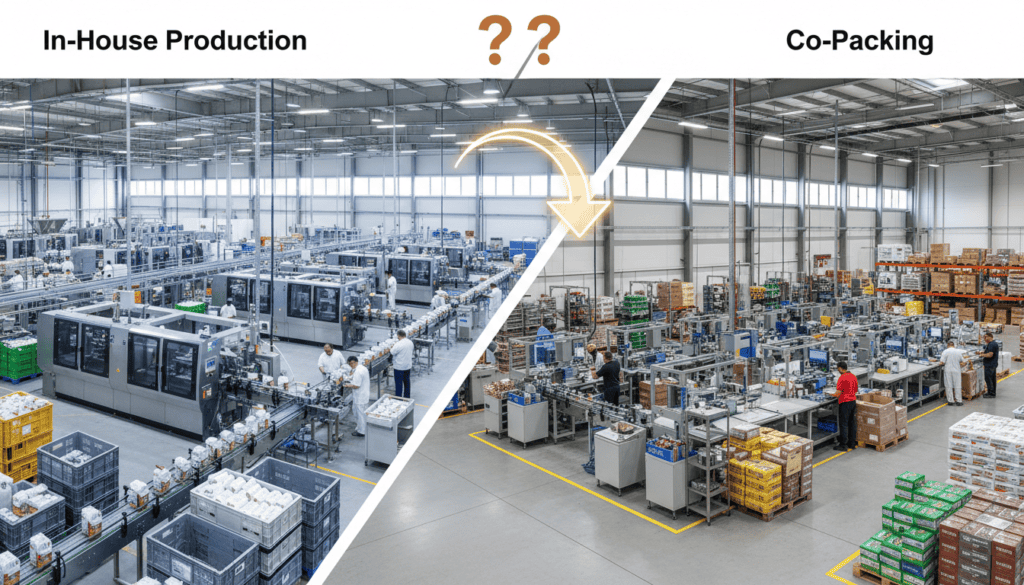
Co-packing—partnering with third-party manufacturers who handle production on your behalf—has become the go-to solution for many emerging brands. Meanwhile, in-house production remains the gold standard for companies seeking complete control over their manufacturing processes.
Here’s the thing: there’s no universal “right” answer. The best choice depends on your specific circumstances, growth trajectory, and strategic objectives.
The Co-Packing Advantage
Lower Upfront Investment
Co-packing eliminates the massive capital requirements of setting up your own manufacturing facility. Instead of investing millions in equipment, facility buildouts, and regulatory compliance, you can start production with relatively modest upfront costs.
Most co-packers require minimum order quantities (MOQs) and setup fees, but these pale in comparison to the investment needed for in-house capabilities. This lower barrier to entry allows brands to test market demand without betting the farm on production infrastructure.
Built-in Expertise and Compliance
Established co-packers bring decades of manufacturing experience to your brand. They’ve already navigated the complex web of FDA regulations, quality certifications, and industry standards that can overwhelm new manufacturers.
This expertise extends beyond compliance. Co-packers often provide valuable input on product formulation, packaging optimization, and process improvements that can enhance your product’s market viability.
Scalability Without Growing Pains
Working with co-packers allows you to scale production up or down based on market demand without the fixed costs of maintaining your own facility. During peak seasons, you can increase production volumes. During slower periods, you’re not stuck with idle equipment and overhead costs.
The reality is that many successful CPG brands have built multi-million dollar businesses without ever owning a manufacturing facility. They focus their resources on brand building, marketing, and distribution while leaving production to the specialists.
Geographic Distribution Benefits
Co-packers often operate multiple facilities across different regions, potentially reducing shipping costs and delivery times to various markets. This geographic diversification can also provide backup options if one facility experiences issues.

The In-House Production Case
Complete Quality Control
When you own the production process, you control every variable. There’s no need to coordinate with external partners or worry about competing priorities. Your quality standards become the only standards that matter.
This control extends to ingredient sourcing, production timing, and quality assurance protocols. You can make real-time adjustments without going through approval processes or dealing with co-packer scheduling constraints.
Higher Profit Margins
In-house production eliminates co-packer markups and fees. While the upfront investment is substantial, the long-term cost per unit is typically lower, especially at higher volumes.
Here’s what works for many established brands: they start with co-packing to prove market demand, then transition to in-house production once volumes justify the investment. This approach provides the best of both worlds—low initial risk with eventual margin optimization.
Intellectual Property Protection
Proprietary formulations and processes remain under your direct control with in-house production. There’s no risk of co-packers working with competitors or inadvertently sharing sensitive information.
For brands with unique manufacturing processes or closely guarded recipes, this protection can be worth the additional investment and complexity.
Speed and Flexibility
In-house production eliminates the coordination challenges inherent in co-packing relationships. Need to rush a production run? No problem. Want to test a new formulation? You can start immediately.
This agility becomes increasingly valuable as brands mature and need to respond quickly to market opportunities or competitive threats.
Key Decision Factors
Volume and Financial Considerations
The economics of production change dramatically with volume. Co-packing makes sense for smaller volumes, while in-house production becomes more attractive as volumes increase.
Consider these volume benchmarks:
- Under 100,000 units annually: Co-packing almost always makes more financial sense
- 100,000-500,000 units: The break-even point varies by product type and complexity
- Over 500,000 units: In-house production often provides better margins
Don’t forget to factor in working capital requirements. Co-packing typically requires payment upon completion, while in-house production spreads costs over time but requires significant upfront investment.
Product Complexity and Specialization
Highly specialized products may be difficult to co-pack, either due to equipment requirements or limited co-packer expertise. Conversely, standard products with established production processes are ideal for co-packing.
Consider your product’s manufacturing requirements:
- Does it require specialized equipment or expertise?
- Are there multiple qualified co-packers in your category?
- How critical are proprietary processes to your competitive advantage?
Growth Trajectory and Timeline
Fast-growing brands often benefit from co-packing’s scalability during rapid expansion phases. Slower, steady growth might justify the patience required to build in-house capabilities.
Think about your three to five-year growth projections. If you’re expecting explosive growth, co-packing provides the flexibility to scale quickly. If growth will be steady and predictable, in-house production might offer better long-term economics.
Regulatory and Quality Requirements
Heavily regulated categories like supplements, organic products, or items requiring specific certifications may benefit from partnering with co-packers who already have necessary approvals.
However, if regulatory compliance is a key competitive advantage or if you need to maintain specific quality protocols, in-house production might be worth the investment.
Hybrid Approaches and Transitions
Most businesses miss this: you don’t have to choose just one approach forever. Many successful CPG brands use hybrid strategies or plan strategic transitions based on their growth stage.
The Staged Approach
Start with co-packing to validate market demand and generate cash flow. Once you reach sufficient volume and profitability, transition to in-house production for better margins and control.
This approach minimizes initial risk while preserving long-term optimization opportunities. You can use early co-packing relationships to learn about production requirements and quality standards before making major investments.
Product Line Segmentation
Some brands use co-packing for certain products while handling others in-house. Core products with high volumes might justify in-house production, while seasonal or specialty items remain with co-packers.
This strategy allows you to optimize economics and control where it matters most while maintaining flexibility for other products.

Making Your Decision
Financial Analysis Framework
Create a detailed financial model comparing both options over a three to five-year period. Include all costs:
Co-packing costs:
- Per-unit production costs
- Setup fees and minimum orders
- Quality control and testing
- Logistics and coordination
In-house production costs:
- Equipment and facility investment
- Staff hiring and training
- Regulatory compliance and certifications
- Ongoing operational expenses
- Working capital requirements
Risk Assessment
Evaluate both options through a risk management lens. Co-packing reduces financial risk but increases operational dependencies. In-house production requires larger upfront investment but provides more control.
Consider scenarios like demand spikes, supply chain disruptions, quality issues, and competitive pressure. How would each production approach handle these challenges?
Strategic Alignment
Your production decision should align with broader business strategy. If speed to market is critical, co-packing might be essential. If product differentiation depends on proprietary manufacturing processes, in-house production could be strategic.
Implementation Best Practices
If You Choose Co-Packing
Selecting the right co-packer is crucial. Don’t just focus on price—evaluate capabilities, capacity, quality systems, and cultural fit. Visit facilities, check references, and understand their other client relationships.
Develop strong contract terms that protect your interests while providing co-packers with reasonable business certainty. Include quality standards, delivery requirements, and intellectual property protections.
Maintain strong oversight even when outsourcing production. Regular quality audits, clear communication protocols, and backup plans are essential for long-term success.
If You Choose In-House Production
Start planning early—facility setup, equipment procurement, and staff hiring can take 12-18 months or longer. Don’t underestimate the complexity of regulatory compliance and quality system development.
Consider starting with a smaller, more flexible facility that can grow with your business. Oversized facilities create unnecessary overhead, while undersized facilities limit growth potential.
Invest heavily in quality systems and staff training from day one. The cost of fixing quality problems after production starts far exceeds the investment in getting it right initially.
Conclusion
The choice between co-packing and in-house production isn’t just about immediate costs—it’s about positioning your brand for long-term success. Consider your financial situation, growth projections, product requirements, and strategic objectives when making this crucial decision.
Remember that this choice isn’t permanent. Many successful brands evolve their production strategies as they grow and their needs change. The key is making an informed decision based on your current situation while keeping future options open.
At Beast Creative Agency, we help CPG brands navigate these complex strategic decisions through data-driven analysis and market insights. Our marketing expertise extends beyond campaigns to include strategic guidance that aligns your operational decisions with your brand’s growth objectives. Whether you choose co-packing or in-house production, we can help ensure your go-to-market strategy maximizes your production investment.