Over 90% of consumer packaged goods never make it past their second year on retail shelves. The difference between products that thrive and those that disappear isn’t luck—it’s strategic development that aligns every stage from initial concept through market launch. Here’s how successful brands navigate this complex journey.

Understanding the CPG Development Landscape
Understanding consumer packaged goods development requires recognizing you’re operating in one of the most competitive retail environments imaginable. Every product category faces constant innovation pressure, shifting consumer preferences, and razor-thin margins for error. The reality is that most product failures happen not because of poor concepts, but due to execution gaps during the development process.
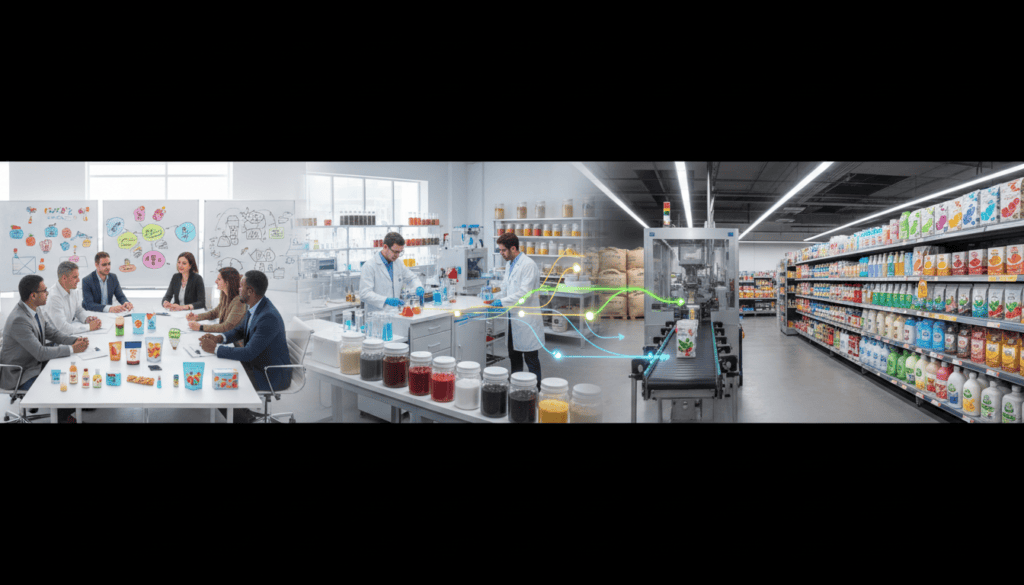
Smart brands recognize that successful CPG development requires coordinating multiple disciplines: market research, product formulation, packaging design, regulatory compliance, manufacturing, and go-to-market strategy. Each element must work seamlessly with the others.
Phase 1: Concept Development and Market Validation
Identifying Market Opportunities
The strongest product concepts emerge from genuine market gaps rather than internal assumptions, which requires understanding consumer behavior and purchase drivers at a fundamental level. This means conducting thorough research before committing resources to development:
- Consumer behavior analysis to understand unmet needs
- Competitive landscape mapping to identify differentiation opportunities
- Trend analysis to ensure long-term market viability
- Price point analysis to determine market acceptance thresholds
Here’s what most brands miss: they fall in love with their product idea before validating market demand. The most successful CPG companies test concepts early and iterate based on real consumer feedback.
Concept Testing and Refinement
Before moving into product development, smart brands validate their concepts through multiple testing methods:
Focus Groups: Provide qualitative insights into consumer reactions, preferences, and potential concerns. These sessions reveal emotional responses that surveys often miss.
Online Surveys: Offer quantitative data about purchase intent, price sensitivity, and feature preferences across larger sample sizes.
Prototype Testing: Even basic mockups help consumers visualize the product and provide more accurate feedback than concept descriptions alone.
Phase 2: Product Formulation and Design
Balancing Performance with Production Reality
The gap between concept and manufacturable product often determines success or failure. Product formulation must consider several competing factors:
- Performance specifications that meet consumer expectations
- Ingredient availability and cost stability
- Shelf life requirements for retail distribution
- Manufacturing scalability from pilot to full production
- Regulatory compliance across target markets
This might surprise you: many products that test beautifully in small batches fail when scaled to commercial production. Temperature variations, mixing speeds, and ingredient interaction changes can dramatically affect final product quality.
Packaging Development Strategy
CPG packaging serves multiple masters—marketing appeal, product protection, cost efficiency, and regulatory requirements, which is why successful brands invest in packaging design strategies that convert browsers into buyers. The development process requires close coordination between several teams:
Structural Design: Creates packaging that protects product integrity while optimizing shipping and shelf space efficiency.
Graphic Design: Develops visual identity that stands out in crowded retail environments while communicating key product benefits.
Materials Engineering: Selects packaging materials that balance cost, sustainability goals, and functional requirements.

Phase 3: Regulatory Compliance and Safety Testing
Navigating Complex Regulatory Requirements
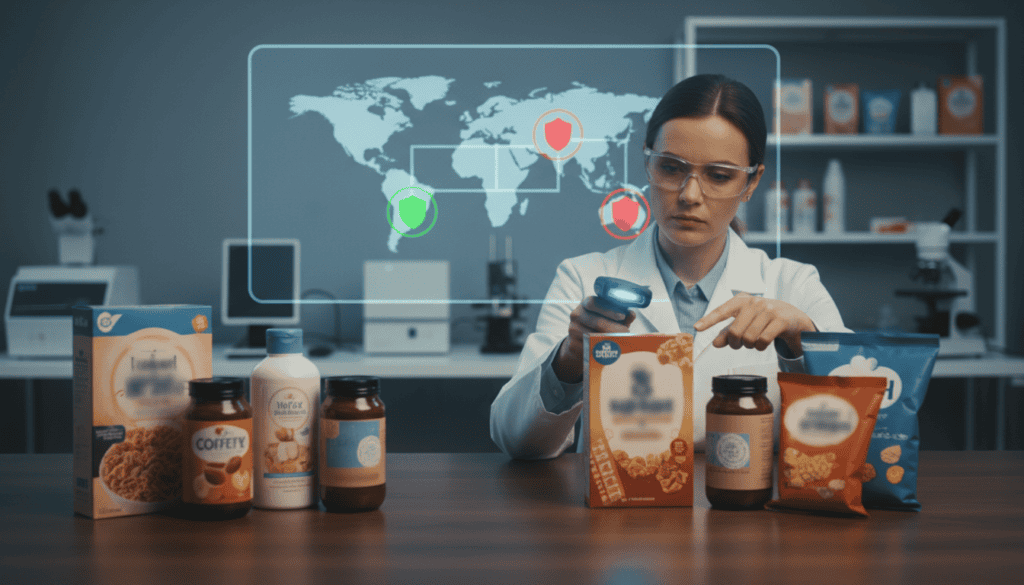
Different product categories face varying regulatory hurdles, but all CPG products must meet basic safety and labeling requirements. The key is building compliance into the development process rather than treating it as a final hurdle.
Common regulatory considerations include:
- FDA registration and facility inspection requirements
- Nutritional labeling accuracy and format compliance
- Ingredient disclosure and allergen warnings
- Claims substantiation for marketing messages
- State-specific regulations for certain product categories
Here’s the thing: regulatory delays can destroy product launch timing. Smart brands engage regulatory experts early in the development process to avoid costly delays later.
Quality Assurance and Testing Protocols
Consistent product quality starts with robust testing protocols during development. This includes establishing quality standards that manufacturing can reliably meet:
Stability Testing: Ensures products maintain quality throughout their intended shelf life under various storage conditions.
Microbiological Testing: Confirms products meet safety standards and won’t pose health risks to consumers.
Performance Testing: Validates that products deliver promised benefits consistently across production batches.
Phase 4: Manufacturing and Supply Chain Setup
Scaling from Prototype to Production
The transition from laboratory to manufacturing floor often reveals hidden challenges. Successful brands plan this transition carefully:
Production trials help identify potential issues before committing to full-scale manufacturing. These trials test everything from ingredient mixing to packaging line speeds.
Supply chain reliability becomes critical at this stage. Smart brands establish relationships with multiple suppliers for critical ingredients to avoid production disruptions.
Quality control systems must scale with production volume. What works for small batches may not catch defects in high-volume production runs.
Cost Optimization Without Compromising Quality
Manufacturing costs directly impact retail pricing and profit margins. However, cutting costs in the wrong areas can destroy product quality and brand reputation.
Most successful brands focus cost optimization efforts on:
- Packaging efficiency improvements that reduce materials without affecting protection
- Ingredient sourcing strategies that ensure quality while managing costs
- Production process optimization that increases throughput without quality compromises
- Waste reduction programs that improve sustainability while cutting costs
Phase 5: Go-to-Market Strategy and Launch Preparation
Retail Partnership Development
Securing retail distribution requires more than a great product—it demands building strong retail partnerships based on mutual value creation. Retailers evaluate potential products based on category performance, brand support, and profit potential.
Successful retail presentations include:
- Market research demonstrating consumer demand
- Clear differentiation from existing category products
- Marketing support plans that will drive consumer trial
- Profit margin analysis showing retailer benefits
- Supply chain capabilities ensuring consistent product availability
The reality is that most retailers see dozens of new product pitches weekly. Standing out requires demonstrating clear value for both consumers and the retail partner.
Marketing and Brand Launch Strategy
Product launch success depends on coordinated marketing efforts that build awareness, drive trial, and encourage repeat purchases.
Pre-Launch Buzz Building: Smart brands start building anticipation before products hit shelves through social media teasers, influencer partnerships, and trade publication coverage.
Launch Phase Activation: The first few weeks determine long-term success. This requires coordinated efforts across digital advertising, in-store promotions, and public relations.
Post-Launch Optimization: Continuous monitoring of sales data, customer feedback, and market response allows for quick adjustments to marketing strategy.

Phase 6: Performance Monitoring and Iteration
Key Performance Indicators for CPG Success
Successful CPG brands track metrics that predict long-term performance, not just initial sales volume:
Sales Velocity: How quickly products move off retail shelves indicates consumer acceptance and repeat purchase behavior.
Market Share Growth: Gaining share in established categories demonstrates competitive advantage and sustainable positioning.
Customer Retention Rates: Repeat purchase behavior indicates product satisfaction and long-term viability.
Distribution Expansion: Growing retail partnerships show retailer confidence in product performance.
Continuous Improvement and Product Evolution
The most successful CPG products evolve based on market feedback and changing consumer needs. This requires systems for collecting and acting on performance data:
Customer feedback programs provide insights into product performance and improvement opportunities. Many brands use social media monitoring, customer service interactions, and formal survey programs.
Sales data analysis reveals patterns in purchase behavior, seasonal variations, and geographic preferences that inform product and marketing decisions.
Competitive monitoring helps identify market changes and emerging threats that require product or positioning adjustments.
Common Pitfalls and How to Avoid Them
Rushing to Market Without Adequate Testing
Time-to-market pressure often leads brands to skip critical testing phases. However, launching prematurely usually costs more than thorough preparation.
Products that fail quality standards after launch face expensive recalls, damaged brand reputation, and lost retail relationships. The cost of fixing problems after launch typically exceeds the cost of preventing them during development.
Underestimating Marketing Investment Requirements
Many brands allocate insufficient resources for launch marketing, assuming great products will sell themselves. In crowded CPG categories, consumer awareness requires consistent marketing investment.
Successful launches typically require marketing budgets equal to 20-30% of first-year revenue projections. Brands that invest less often struggle to achieve the awareness levels needed for retail success.
Building Long-term Brand Success
Sustainable CPG success requires thinking beyond individual product launches to overall brand strategy. This means developing systems and capabilities that support multiple products over time.
Brand equity building starts with the first product but extends across the entire product portfolio. Consistent quality, reliable performance, and authentic brand messaging create the foundation for long-term success.
Innovation pipeline development ensures brands can continue launching successful products as markets evolve. This requires ongoing investment in research, development capabilities, and market intelligence.
The brands that thrive long-term are those that view product development as an ongoing capability rather than a one-time project. They build systems, relationships, and expertise that compound over multiple product launches.
At Beast Creative Agency, we understand that successful CPG launches require coordinated efforts across product development, marketing strategy, and brand building. Our AI-enhanced campaigns and data-driven approach help brands navigate the complex journey from concept to shelf success. Ready to turn your CPG concept into a market winner? Let’s discuss how our proven strategies can accelerate your product development timeline while maximizing your launch success potential.