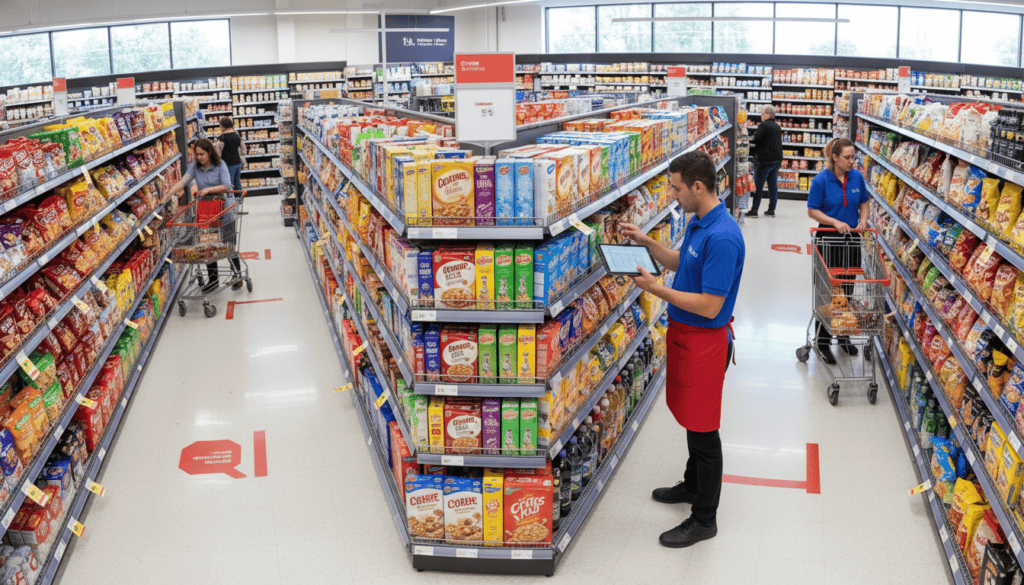
While 83% of purchase decisions happen at the point of sale, most CPG brands still struggle with inconsistent shelf presence and poor in-store execution. The gap between marketing strategy and retail reality costs companies millions in lost revenue annually. Mastering retail execution isn’t just about getting products on shelves—it’s about creating systematic visibility that drives consistent sales growth.

Understanding CPG Retail Execution Fundamentals
Retail execution represents the final mile of your CPG marketing strategy. It’s where all your brand positioning, advertising spend, and product development efforts either pay off or fall flat. Here’s the thing: you can have the most brilliant marketing campaign in the world, but if your products aren’t properly displayed, priced, or positioned in stores, you’re essentially throwing money away.
Effective retail execution encompasses several key elements that work together to maximize your brand’s in-store performance. These include planogram compliance, promotional execution, inventory management, and competitive analysis. Each component requires careful coordination between your sales teams, retail partners, and field representatives.
The Cost of Poor Execution
Most businesses miss this critical connection: every day your product sits in the stockroom instead of on the shelf represents lost sales that you’ll never recover. Research shows that out-of-stock situations can cost CPG brands up to 4% of their annual sales. When you factor in promotional periods and peak seasons, these losses compound quickly.
Poor retail execution also damages long-term brand equity. Inconsistent shelf presence, incorrect pricing, and suboptimal product placement create confusion among consumers and erode the trust you’ve worked hard to build through your marketing efforts.
Building a Data-Driven Execution Strategy
The reality is that successful retail execution starts with robust data collection and analysis. You can’t improve what you don’t measure, and traditional gut-feeling approaches to retail management simply don’t cut it in today’s competitive landscape.
Essential Metrics to Track
Your retail execution dashboard should focus on these core performance indicators:
- Share of shelf: How much linear and facing space you’re capturing compared to competitors
- Planogram compliance: Percentage of stores following agreed-upon product placement
- Inventory turns: How quickly products move off shelves across different locations
- Promotional execution rate: Accuracy of price changes, display setup, and marketing material placement
- Distribution depth: Product availability across different SKUs and package sizes
These metrics provide the foundation for making informed decisions about where to focus your execution efforts and resources.
Technology Integration for Real-Time Insights
Modern retail execution relies heavily on mobile technology and cloud-based platforms that give you real-time visibility into store conditions. Field teams can now capture photos, update inventory counts, and report compliance issues instantly, allowing for faster response times and more accurate data collection.
AI-powered image recognition tools are revolutionizing how brands monitor shelf conditions. These systems can automatically detect out-of-stocks, measure share of shelf, and identify planogram violations from simple smartphone photos. This technology reduces manual reporting errors and provides more consistent data across your entire retail network.

Optimizing Product Placement and Merchandising
Here’s what works: strategic product placement that considers both consumer behavior and retailer objectives. The most successful CPG brands understand that prime shelf real estate isn’t just about paying for better positions—it’s about proving that your products deserve those spots through consistent performance.
The Science of Shelf Psychology
Eye-level placement remains king, but the definition of “eye level” varies by category and target demographic. For children’s products, lower shelves often perform better. For premium items targeting older consumers, slightly higher placement can reinforce quality perceptions.
Vertical blocking—placing all your SKUs in a vertical column rather than spreading them horizontally—typically increases sales by creating a stronger brand presence. This approach makes it easier for loyal customers to find your products while also attracting new buyers through increased visual impact.
Cross-Merchandising Opportunities
Smart CPG brands look beyond their primary category placement to identify cross-merchandising opportunities. This might surprise you: products placed in secondary locations often generate incremental sales without cannibalizing primary shelf performance.
Consider these high-impact cross-merchandising strategies:
- Seasonal tie-ins that connect your product to holiday or weather-related purchases
- Recipe-based adjacencies that group complementary food items together
- End-cap displays during promotional periods that capture impulse purchases
- Checkout lane placement for smaller package sizes or trial products
Managing Promotional Execution Excellence
Promotional periods represent make-or-break moments for CPG brands. These high-stakes windows can generate significant sales lifts when executed properly, or result in disappointed customers and damaged retailer relationships when things go wrong.
Pre-Promotion Planning
Successful promotional execution starts weeks before the actual promotion begins. You need to ensure adequate inventory is in place, promotional materials are distributed and ready for installation, and all stakeholders understand their roles and responsibilities.
Create detailed promotion checklists that cover:
- Inventory verification and replenishment schedules
- Point-of-sale material distribution and setup instructions
- Pricing change coordination with store management
- Display build requirements and maintenance protocols
- Compliance monitoring and issue escalation procedures
Real-Time Promotion Monitoring
Most businesses don’t realize how quickly promotional execution can go off track. Price changes might not take effect on schedule, displays could be built incorrectly, or inventory might run low faster than anticipated. Having systems in place to monitor these issues in real-time allows you to address problems before they significantly impact sales.
Field teams should be equipped with mobile tools that make it easy to report execution issues and request support. The faster you can identify and resolve problems, the more promotional sales you’ll capture.
Strengthening Retailer Partnerships
Here’s the reality: your success depends heavily on building strong relationships with retail partners. Store managers and category buyers who trust your brand and see you as a valuable partner are more likely to give you better placement, support your promotional activities, and alert you to opportunities for growth.
Creating Mutual Value
The best retailer relationships are built on mutual benefit rather than one-sided demands. When presenting new products, promotional plans, or placement requests, always lead with how the proposal will benefit the retailer—increased category sales, improved margins, enhanced customer satisfaction.
Regular business reviews with key retail partners should focus on:
- Category performance trends and growth opportunities
- Consumer insights that can inform assortment and merchandising decisions
- Joint promotional planning that maximizes impact for both parties
- Operational improvements that reduce costs and increase efficiency
Communication and Transparency
Consistent, proactive communication builds trust and prevents small issues from becoming major problems. Regular check-ins with store management, prompt follow-up on issues, and transparent reporting on promotional performance all contribute to stronger partnerships.
When problems do arise—and they will—address them quickly and honestly. Retailers appreciate partners who take ownership of issues and work collaboratively toward solutions rather than making excuses or shifting blame.

Measuring and Improving Long-Term Performance
Effective retail execution is an ongoing process that requires continuous monitoring, analysis, and improvement. The brands that consistently outperform their competitors are those that treat retail execution as a strategic capability rather than a tactical afterthought.
Performance Analysis and Optimization
Monthly performance reviews should examine both quantitative results and qualitative feedback from field teams and retail partners. Look for patterns in execution challenges, successful strategies that can be replicated across more locations, and opportunities to streamline processes.
Don’t just focus on your own performance—regular competitive analysis helps you understand how your execution compares to other brands and identify areas where you can gain advantages through superior execution.
Team Development and Training
Your field execution team represents your brand in thousands of daily interactions with retailers and consumers. Investing in their training, tools, and professional development pays dividends in improved execution quality and stronger retailer relationships.
Regular training should cover product knowledge, merchandising best practices, relationship building skills, and technology tools. But here’s what many companies miss: your field team often has the best insights into what’s working and what isn’t. Create formal channels for capturing and acting on their feedback.
Future-Proofing Your Execution Strategy
The retail landscape continues to evolve rapidly, with new technologies, changing consumer behaviors, and shifting retailer priorities creating both challenges and opportunities for CPG brands. Building flexibility into your execution strategy helps you adapt quickly to these changes.
Emerging Technology Integration
Artificial intelligence and machine learning are beginning to transform retail execution through predictive analytics, automated reporting, and optimized resource allocation. Brands that start experimenting with these technologies now will have significant advantages as they mature.
Internet of Things (IoT) sensors can provide real-time inventory data, temperature monitoring for sensitive products, and consumer interaction insights that were previously impossible to capture. While still emerging, these technologies will likely become standard tools for retail execution in the coming years.
Adapting to Retail Evolution
The rise of e-commerce, changing store formats, and new retail models require flexible execution strategies that can work across different environments. What works perfectly in traditional grocery stores might need significant adaptation for convenience stores, club retailers, or emerging pickup-and-delivery formats.
Stay close to your retail partners as they experiment with new concepts and be ready to adapt your execution approach to support their innovations. Early adoption of new retail formats often provides first-mover advantages that can be difficult for competitors to overcome.
Maximizing ROI Through Strategic Focus
Not all stores, categories, or time periods offer equal opportunities for execution improvement. The most successful CPG brands focus their resources on the highest-impact situations where superior execution can drive meaningful business results.
Use data analysis to identify your highest-opportunity locations—stores where small execution improvements can generate significant sales increases. These might be high-volume locations where you’re underperforming, stores in growing markets, or locations where competitive activity is creating share-shift opportunities.
Similarly, focus extra attention on peak selling periods when execution mistakes are most costly. Holiday seasons, back-to-school periods, and other category-specific peak times deserve enhanced monitoring and support to ensure you capture maximum sales potential.
Remember that retail execution excellence is a journey, not a destination. Consumer preferences evolve, new competitors enter markets, and retail formats continue to change. The brands that consistently win are those that treat retail execution as a core competency worthy of ongoing investment and attention.
At Beast Creative Agency, we understand that even the most brilliant marketing campaigns fall short without flawless retail execution. Our AI-enhanced approach to campaign development includes detailed execution planning that ensures your brand message translates effectively to the point of sale. Ready to bridge the gap between marketing strategy and retail reality? Let’s create campaigns that work seamlessly from conception through execution.