
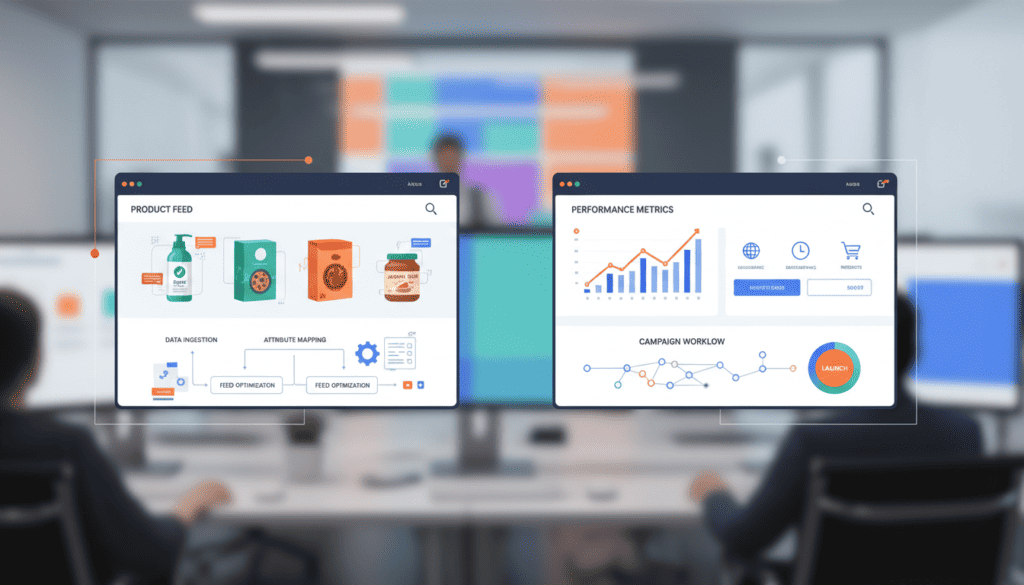
Ninety-one percent of CPG brands lose potential customers before they even click on their Google Shopping ads—not because of price or product appeal, but because their product feeds are fundamentally broken. While competitors pour budgets into bid strategies and audience targeting, the real competitive advantage lies in feed architecture and campaign structure that most brands completely overlook. Understanding how Google Shopping fits into a broader consumer packaged goods marketing strategy is essential before diving into the technical details.

Understanding Google Shopping Ads for CPG Brands
Consumer Packaged Goods (CPG) brands face unique challenges in the Google Shopping ecosystem. Unlike single-product retailers, CPG companies manage vast catalogs with multiple SKUs, seasonal variations, and complex product hierarchies. Your breakfast cereal isn’t just “cereal”—it’s organic, gluten-free, family-size, honey-flavored cereal that competes against hundreds of similar products.
Here’s the thing: Google Shopping ads don’t work like traditional search campaigns. You can’t bid on keywords or write custom ad copy. Instead, Google pulls everything from your product feed—titles, descriptions, prices, images, and availability. This means your product feed becomes your entire advertising strategy.
The stakes are high. Google Shopping ads typically drive 60-80% of retail search ad clicks, and CPG brands that get their feeds right see average ROAS improvements of 150-300% compared to poorly optimized competitors. To put this in context, Google Shopping is just one piece of a larger paid channel strategy for CPG brands that also includes social, display, and programmatic advertising.
Product Feed Optimization: The Foundation of Success
Product Title Optimization
Your product titles carry the heaviest weight in Google Shopping performance. Most CPG brands make the mistake of using manufacturer product names or internal SKU descriptions that mean nothing to consumers.
Here’s what works for CPG product titles:
- Lead with brand name: Start with your recognizable brand, not generic descriptors
- Include key attributes: Size, flavor, pack count, and primary benefit
- Use consumer language: “Family Size” instead of “48 oz,” “Crunchy” instead of “Textured”
- Front-load important information: Put the most search-relevant terms in the first 70 characters
Bad example: “Morning Crunch Breakfast Cereal – SKU#12345”
Good example: “Kellogg’s Frosted Flakes Original Family Size Cereal 24 oz Box”
The second title tells Google exactly what searchers want to know: brand, product type, flavor, size, and format.
Product Descriptions That Convert
While titles get you found, descriptions drive conversions. CPG brands often underestimate description impact because they’re not visible in the shopping card preview. But Google uses description content for matching relevance, and shoppers see descriptions when they click through.
Effective CPG descriptions include:
- Key nutritional benefits or dietary accommodations
- Usage occasions (“perfect for breakfast” or “great for packed lunches”)
- Ingredient highlights that differentiate your product
- Pack size and value propositions
Category and Product Type Mapping
Google’s product categories determine which searches trigger your ads. Many CPG brands choose overly broad categories, diluting their relevance. Instead of selecting “Food & Beverage,” drill down to “Food & Beverage > Beverages > Soft Drinks > Soda” for a cola product.
Custom product types give you additional control. Create hierarchical product types that reflect how customers actually shop:
- Level 1: Snacks
- Level 2: Chips
- Level 3: Potato Chips
- Level 4: Flavored Potato Chips
This structure enables precise campaign targeting and performance analysis.
Image Quality and Standards
Product images make or break CPG Shopping campaigns. Your cereal box photo competes directly against name brands with professional photography budgets. Here’s what converts:
- High resolution: Minimum 800×800 pixels, with 1200×1200 preferred
- Clean backgrounds: Pure white backgrounds perform best
- Product prominence: The actual product should fill 75-90% of the image space
- Lifestyle context: For appropriate products, show usage context (cereal in a bowl with milk)
Most businesses miss this: Google favors images that clearly communicate product size and packaging. If you’re selling a 12-pack, show all 12 units. If it’s family-size, include size context in the image.

Campaign Structure Strategy for CPG Brands
Campaign Architecture
CPG brands need campaign structures that reflect their product diversity and business goals. Don’t throw all products into one massive campaign—Google’s algorithm needs clear signals about your priorities.
Here’s a proven campaign structure approach:
Campaign Level 1: Brand Protection
Create dedicated campaigns for your branded search terms. These campaigns should include only your core products and use higher bids to ensure visibility when people search for your brand specifically.
Campaign Level 2: Product Category
Separate campaigns by major product categories—breakfast items, snacks, beverages, etc. This structure allows budget allocation based on category performance and seasonality.
Campaign Level 3: Performance Tiers
Within categories, create separate campaigns for high-performers, new products, and clearance items. Each tier gets different bidding strategies and budget priorities.
Ad Group Organization
Your ad groups should reflect how customers think about your products, not how your warehouse organizes inventory. Group products that compete for similar searches and have comparable profit margins.
Effective ad group themes for CPG brands:
- Product type + key attribute (Organic Breakfast Cereals)
- Usage occasion (On-the-Go Snacks)
- Dietary restrictions (Gluten-Free Products)
- Package size (Family Size Items)
Bidding Strategy Selection
CPG brands often struggle with bidding because they’re managing hundreds or thousands of SKUs with varying margins. Here’s what works:
Target ROAS: Best for established products with clear conversion data. Set targets based on actual profit margins, not revenue.
Maximize Conversion Value: Ideal for brands with strong seasonal patterns. Google optimizes for total conversion value within your budget.
Enhanced CPC: Good for new product launches where you need more control while building conversion data.
Negative Keyword Strategy
Shopping campaigns don’t use traditional keyword targeting, but negative keywords are essential for CPG brands. Common negative keywords for CPG include:
- Competitor brand names (unless you specifically want to compete)
- “Free,” “sample,” “coupon” (unless you’re running promotions)
- “DIY,” “homemade,” “recipe” (people looking to make, not buy)
- “Wholesale,” “bulk” (unless you sell B2B)
Advanced Feed Management Techniques
Seasonal and Promotional Updates
CPG products often have seasonal demand patterns. Your feed management should reflect these cycles through:
- Title modifications: Add “Holiday” or “Summer” descriptors during peak seasons
- Priority adjustments: Boost seasonal products in campaign priority
- Custom labels: Use custom labels to identify and manage seasonal inventory
- Sale price scheduling: Automate promotional pricing updates
Inventory Management Integration
Nothing hurts CPG Shopping performance like out-of-stock products still showing ads. Connect your product feed to real-time inventory systems:
- Automatically pause products when inventory drops below minimum thresholds
- Adjust bids based on inventory levels—reduce bids for low-stock items
- Use inventory counts in custom labels for performance analysis
Multi-Pack and Size Variation Handling
CPG brands typically sell the same product in multiple sizes and pack configurations. Handle these variations strategically:
- Create separate feed entries for each size/pack combination
- Use consistent naming conventions across all variations
- Include unit pricing information when relevant
- Group similar variations in the same ad groups for unified management

Performance Monitoring and Optimization
Key Metrics for CPG Shopping Campaigns
Traditional ecommerce metrics don’t always apply to CPG brands. Focus on metrics that reflect your business model:
- ROAS by product category: Understand which product lines drive profitability
- Customer acquisition cost: Measure long-term customer value, not just first purchase
- Share of Voice: Track visibility compared to competitors for key products
- Click-through rate by product type: Identify which products resonate with searchers
For a deeper look at how ROAS and customer acquisition cost fit into a full-funnel measurement framework, see this guide on CPG performance marketing attribution and ROAS optimization.
Feed Quality Monitoring
Google provides feed quality indicators that many CPG brands ignore. Monitor these regularly:
- Product disapprovals and reasons
- Feed processing errors
- Item-level issues and warnings
- Policy violations across your catalog
Set up automated alerts for feed issues. A single processing error can disapprove hundreds of products instantly.