CPG brands waste over $37 billion annually on Facebook and Instagram ads that fail to convert, primarily due to generic creative strategies and broad targeting approaches. The fast-moving consumer goods industry demands precision in both visual storytelling and audience segmentation to cut through the noise of social media feeds. For brands evaluating how to structure their overall paid media approach, a specialist CPG marketing partner can make the difference between wasted spend and scalable growth. Here’s how successful CPG brands are rewriting the playbook for social advertising success.

Understanding the CPG Social Media Challenge
Consumer packaged goods face unique hurdles in social media advertising. Unlike service-based businesses, CPG brands must convince consumers to switch from established purchasing habits for products they buy regularly. Your audience isn’t searching for solutions—they’re scrolling through entertainment content when your ad interrupts their experience.
The challenge becomes even more complex when you consider the purchasing cycle. Most CPG products have short consideration periods but long repurchase cycles. Someone might see your energy drink ad today but won’t need to buy again for weeks. This reality demands a completely different approach to creative development and audience targeting than traditional advertising methods. Understanding how consumers move through the CPG buying journey in 2025 is essential context for building campaigns that actually convert.
The Psychology of CPG Social Media Buying
Social media users interact with CPG ads differently than they do with other product categories. They’re not actively problem-solving; they’re seeking entertainment, connection, or information. Your ads must work harder to stop the scroll and create desire for products they might not realize they need.
Research shows that CPG buyers on social platforms respond best to content that feels native to the platform rather than overtly promotional. This means your million-dollar product photography might perform worse than user-generated content shot on a smartphone.
Creative Best Practices That Drive CPG Conversions
Lead With Benefits, Not Features
Your protein powder’s 25 grams of whey isolate means nothing to someone scrolling Instagram. But “fuel your 6 AM workout without the afternoon crash” speaks directly to their lifestyle challenges. Here’s what works:
- Start videos with the end result, not the product
- Show your product solving real problems in real environments
- Use language your customers actually use, not marketing speak
- Focus on emotional outcomes rather than technical specifications
The Power of Social Proof in CPG Creative
User-generated content consistently outperforms professional photography for CPG brands on social media. Consumers trust other consumers more than they trust brands. But there’s a strategic way to approach UGC that most brands miss.
Don’t just repost customer photos—create structured UGC campaigns that guide content creation. Provide loose creative direction that maintains authenticity while ensuring your brand message comes through clearly. The most effective CPG brands develop content partnership programs with micro-influencers who genuinely use their products. Learn more about building these relationships in our guide to finding and working with content creators for CPG influencer marketing.
Video Creative That Actually Converts
The first three seconds determine everything. Most CPG brands waste these crucial moments with logo animations or product glamour shots. Instead, start with movement, transformation, or unexpected visuals that create pattern interrupts.
Effective CPG video structures follow this formula:
- Hook (0-3 seconds): Create curiosity or show immediate benefit
- Problem/Solution (3-8 seconds): Present relatable challenge and your product as the answer
- Proof (8-12 seconds): Show results, testimonials, or demonstrations
- Call-to-Action (12-15 seconds): Clear next step with urgency or incentive
Platform-Specific Creative Optimization
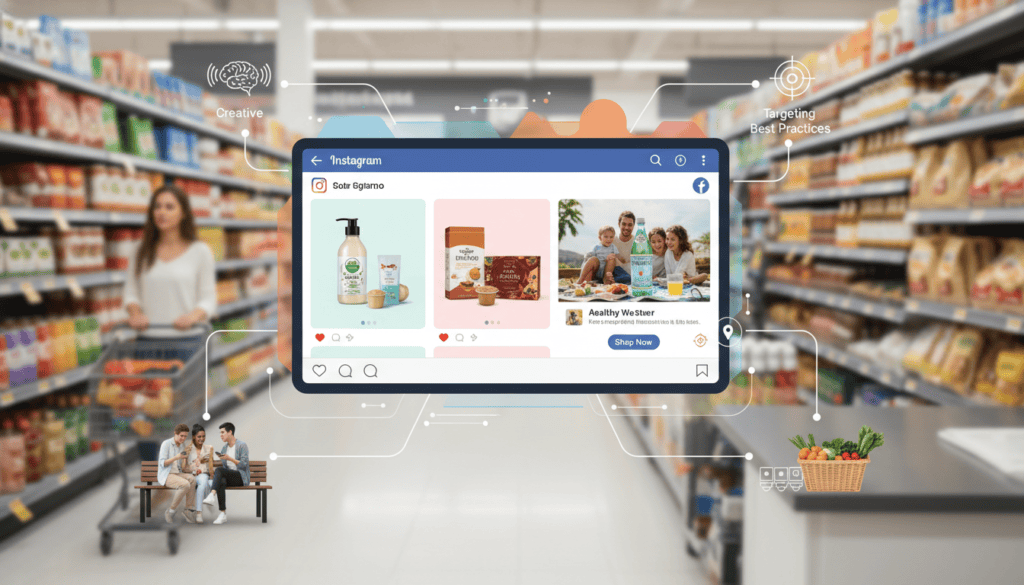
Facebook and Instagram require different creative approaches, even when targeting the same audience. Facebook users tolerate longer-form content and detailed explanations. Instagram users expect immediate visual impact and concise messaging.
For Facebook, test educational content that positions your product as the solution to common problems. Think recipe videos for food brands or fitness routines for supplement companies. Instagram performs better with lifestyle-focused content that shows your product integrated naturally into aspirational scenarios. Brands expanding beyond these two platforms should also explore YouTube, TikTok, and short-form video strategies built specifically for CPG brands.

Advanced Targeting Strategies for CPG Brands
Moving Beyond Demographics
Age, gender, and location targeting worked when Facebook’s algorithm was less sophisticated. Today’s most successful CPG campaigns focus on behavioral and interest-based targeting that reveals purchase intent and lifestyle alignment.
The key is understanding the difference between your customer avatar and your actual customers. Your protein powder might target fitness enthusiasts, but your highest-converting audience could be busy professionals looking for convenient nutrition solutions.
Interest Stacking for Precision Targeting
Single interests cast too wide a net; interest stacking creates more qualified audiences. Instead of targeting “fitness,” combine interests like “meal prep,” “time management,” and “health supplements.” This approach finds people at the intersection of multiple relevant behaviors.
Here’s what effective interest stacking looks like for different CPG categories:
- Beauty Products: Skincare routines + anti-aging + premium beauty brands
- Snack Foods: Healthy eating + busy lifestyle + specific dietary preferences
- Beverages: Energy drinks + productivity + specific activities or sports
Lookalike Audiences That Actually Work
Most CPG brands create lookalike audiences from website visitors or email subscribers. These audiences often underperform because they’re based on people who showed interest, not people who actually purchased.
Build lookalikes from your highest-value customer segments instead. Use purchase data to identify customers who bought multiple times or spent above average amounts. These smaller, more qualified seed audiences typically produce better-performing lookalike audiences.
Behavioral Targeting Beyond Purchase History
Facebook’s behavioral targeting options reveal purchase patterns and lifestyle choices that demographics can’t capture. CPG brands should test these often-overlooked targeting options:
- Mobile device usage patterns (Android vs. iOS often correlates with spending habits)
- Travel behavior (frequent travelers buy different CPG products)
- Shopping behavior across different channels
- Digital activity patterns that indicate lifestyle preferences
Campaign Structure and Budget Allocation
The CPG Campaign Testing Framework
CPG products need different testing methodologies than other industries. Your testing framework should account for seasonal variations, inventory cycles, and the longer customer lifetime value of successful acquisitions.
Start with broad targeting and multiple creative variations. Let Facebook’s algorithm identify your best-performing combinations, then create focused campaigns around winning elements. This approach works better than starting with narrow targeting that might miss unexpected high-converting audience segments.
Budget Distribution Strategy
Allocate 60% of your budget to proven winners, 30% to scaling successful campaigns to new audiences, and 10% to testing completely new approaches. This distribution ensures consistent performance while allowing for growth and innovation.
Most CPG brands make the mistake of spreading budgets too thin across too many campaigns. Concentrate spending on campaigns that achieve your target return on ad spend, then gradually expand successful campaigns to similar audiences.
Measuring Success Beyond ROAS
Return on ad spend is important, but it doesn’t tell the complete story for CPG brands. Customer lifetime value, repeat purchase rates, and brand awareness metrics provide crucial context for campaign optimization decisions.
Track these essential metrics for complete campaign evaluation:
- First-purchase conversion rate and average order value
- Repeat purchase rate within 30, 60, and 90 days
- Customer acquisition cost compared to lifetime value
- Brand awareness lift through reach and frequency analysis
- Cross-sell and upsell rates from social media acquired customers
Attribution Challenges and Solutions
iOS updates have complicated attribution tracking, but CPG brands can still measure campaign effectiveness through first-party data collection and customer surveys. Set up post-purchase surveys asking how customers discovered your brand. This qualitative data often reveals social media’s true impact on purchase decisions. For a deeper look at solving attribution, CAC, and ROAS challenges specific to this industry, see our guide to CPG performance marketing optimization.

Seasonal and Promotional Campaign Strategies
CPG brands must align social media campaigns with retail calendars, seasonal demand patterns, and inventory availability. Your advertising calendar should anticipate demand spikes and prepare creative assets that capitalize on seasonal motivations.
Different product categories have unique seasonal patterns:
- Health and wellness products: Peak in January, September, and before summer
- Food and beverages: Align with holidays, weather changes, and cultural events
- Beauty products: Coordinate with fashion seasons and special occasion calendars
Promotional Campaign Optimization
Discount promotions can drive immediate sales but potentially harm long-term brand perception. Test value-add promotions instead of straight discounts. Bundle complementary products, offer exclusive access, or provide educational resources that enhance the purchase experience.
Advanced Optimization Techniques
Creative Fatigue Management
CPG ads experience creative fatigue faster than other industries because consumers see them more frequently across multiple touchpoints. Monitor frequency metrics closely and refresh creative assets before performance declines.
Develop creative asset libraries organized by themes, benefits, and seasonal relevance. This preparation allows for quick creative rotation when performance metrics indicate fatigue.
Cross-Platform Synergy
Coordinate your Facebook and Instagram campaigns to create cohesive brand experiences without redundant ad delivery. Use Facebook for detailed product education and Instagram for lifestyle positioning. Sequential messaging across platforms can guide prospects through longer consideration cycles.
The reality is that most successful CPG social media campaigns use integrated approaches that recognize how consumers move between